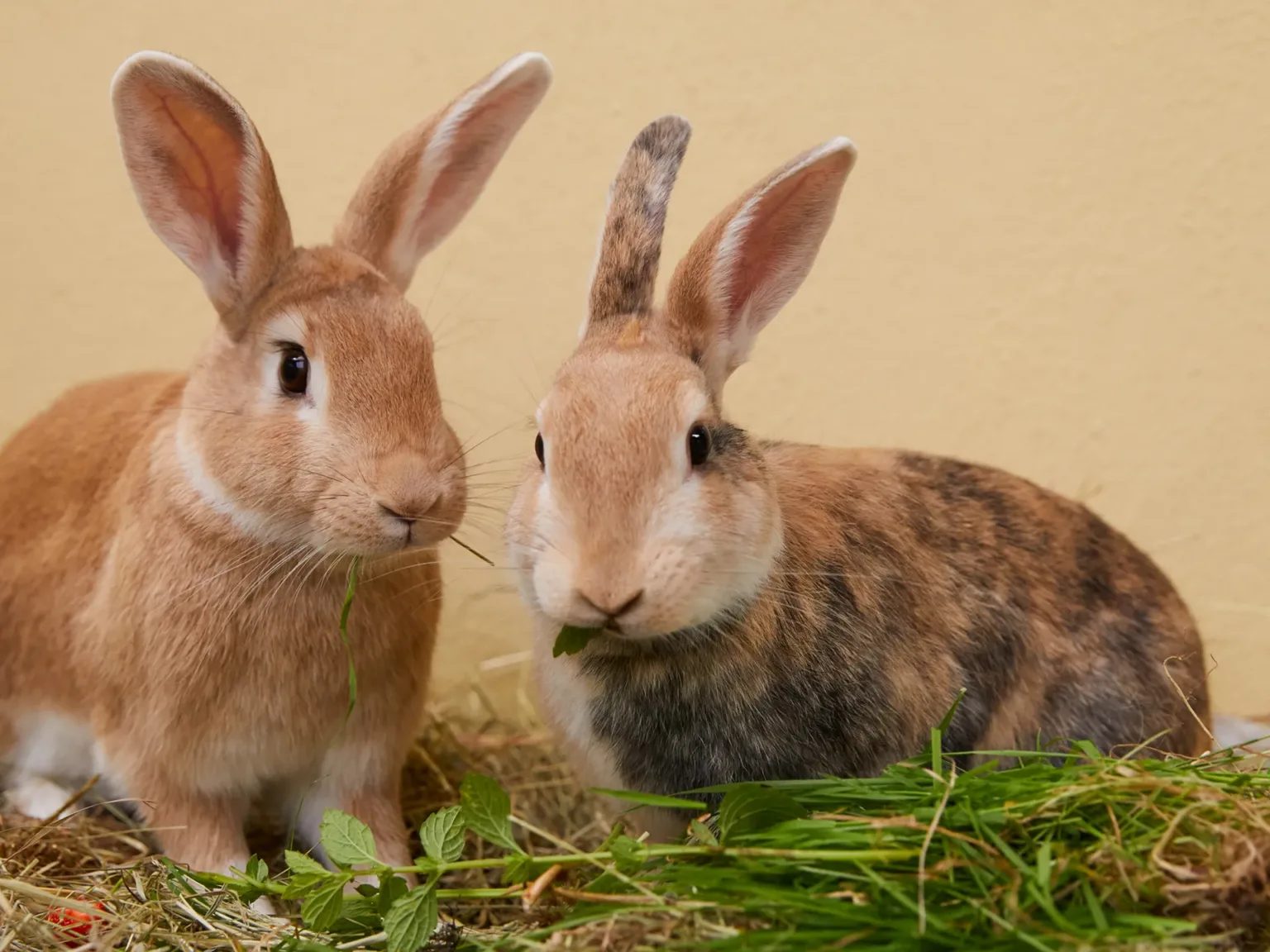
Two rabbits sit close together on hay, eating fresh green grass and leaves, against a light yellow background. One rabbit has light brown fur, and the other has a mix of brown and black fur.

Caring for rabbits

If you’re a rabbit owner, or you’re thinking about getting rabbits, we’re here to help – every step and hop along the way.

In this guide you’ll find everything you need to know to keep rabbits happy and healthy. And if you don’t already have rabbits, we hope you’ll feel better equipped to answer the question: “Are rabbits the right pet for me?”

Whilst rabbits are incredibly cute and a popular choice for a pet, they have a variety of specific needs which many people aren’t aware of. They love (and need) a spacious environment to explore, a rabbit friend for company, and tasty, healthy food to graze on.

Rabbits are also adventurous and inquisitive, but they like their independence and don’t enjoy being picked up and handled. Although, with time and patience, they’re known to form bonds with their owners. If you’re lucky, they might even hop onto your lap occasionally for a tasty treat!

Rabbit facts

  • Male name: Buck.
  • Female name: Doe.
  • Life expectancy: 8-12 years, plus.
  • Companionship: Rabbits need to be housed as a neutered pair, or more.
  • Accommodation: They need lots of space to keep them fit, healthy and happy. And they can live indoors or outdoors (although each rabbit’s specific needs may vary).
  • Diet: Rabbits are herbivores and their diet should consist of 85% hay/ grass, 5% nuggets, 10% vegetables and safe plants, with fresh drinking water always available.
  • Health: They need two vaccinations a year – one which covers myxomatosis and rabbit viral haemorrhagic disease (RVHD1 and RVHD2). The other vaccination covers the new more highly virulent strain of RVHD2.
  • Family-friendly: Many rabbits enjoy the companionship of humans and will approach you to take food from your hands. But it’s important to know they do not enjoy being handled. In fact, they may kick and scratch if you try!

They’re also quite fearful of loud noises and sudden movements, so you’ll need to take this into consideration if you have young children – especially if they’ve not experienced owning a pet before. If you feel confident that you could give rabbits the sort of home and life they need, they could still make a wonderful addition to your family.

Back to contents

Accommodation

Rabbits are active animals – they love to run, dig, hop and jump. As they’re most active at dawn, dusk and overnight, it’s important to provide them with spacious housing to use 24 hours a day. This will help to keep them active, happy and healthy.


The minimum size requirements for a pair of small to medium-sized rabbits

  • Outdoor enclosure – This must be either a wooden shed or Wendy House measuring 1.5m x 1.5m or 1.8m x 1.2m (or larger), or a 1.8m (6ft) single level hutch attached to (or hutch can be placed within) a 3m long x 2m wide by 1m high run.
A large, green wooden and wire outdoor enclosure stands in a garden, with a door open on the left and trees in the background. The enclosure contains animal housing items like boxes and blankets.

A shed attached to a walk in run with hiding spaces, platforms and hay.

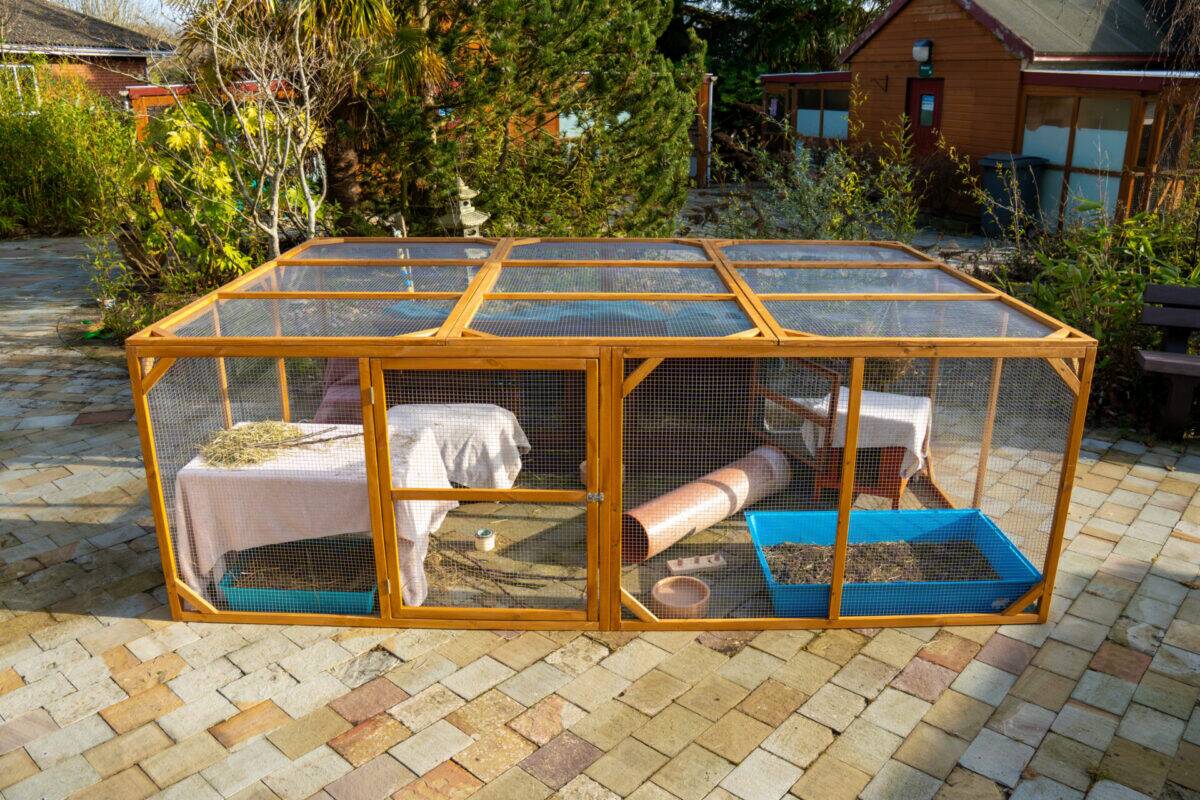
A large wooden and wire outdoor rabbit hutch with two blue litter trays, hay, and tunnels inside, sitting on a paved patio surrounded by plants and wooden buildings.

A run with a hutch inside, litter trays, a tunnel, dig tray and puzzle feeders.

  • Indoor housing – This should be a rabbit-safe room, which measures at least 3m long by 2m wide. They should ideally have access to an outdoor run for the warmer months, which is needs to be 3m long by 2m wide by 1m high
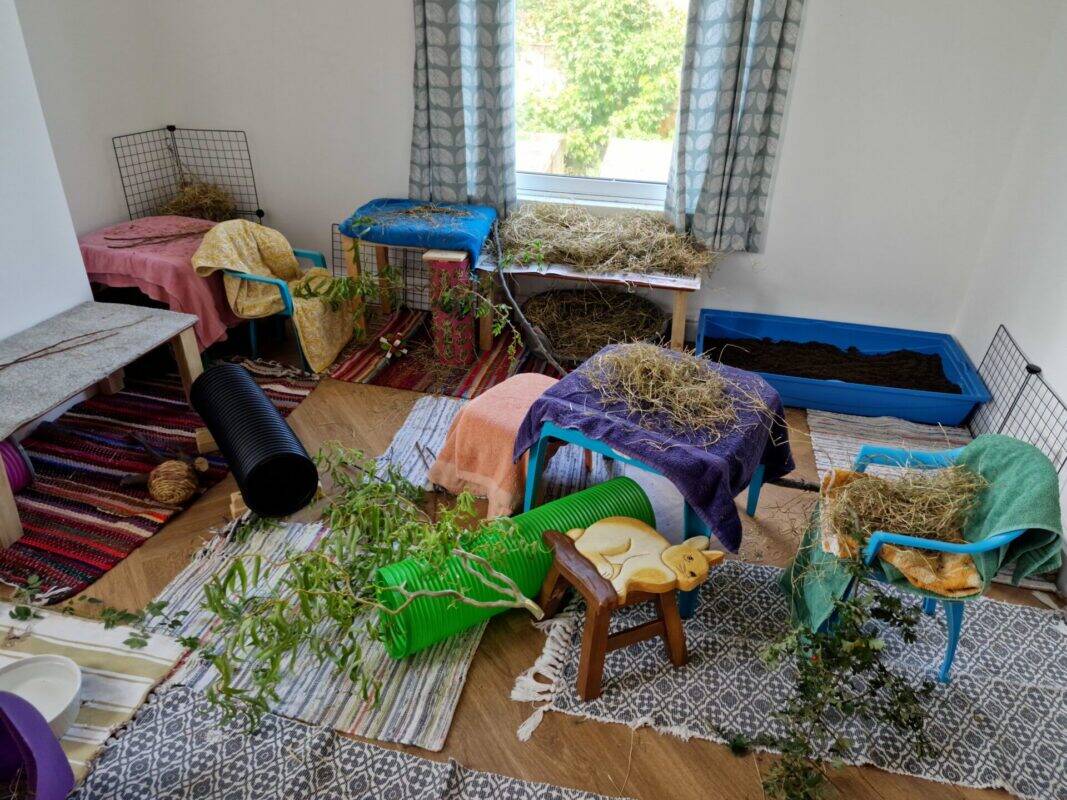
A brightly lit room with cages, tunnels, hay piles, branches, and towels set up on furniture and carpets, creating an indoor play area for small animals like guinea pigs or rabbits. A window with curtains lets in natural light.

A rabbit safe room set up with lots of hiding spaces, platforms, a dig tray and rugs covering the floor.

The minimum size requirements for a pair of large-sized rabbits

  • Outdoor enclosure – This must be 1.5m x 1.5m or 1.8m x 1.2m (or larger) wooden shed/ wendy house, attached to a 3m long by 2m wide by 1.2m.


The minimum size requirements for a pair of giant-sized rabbits

  • Outdoor enclosure – This must be 1.5m x 1.5m or 1.8m x 1.2m (or larger) wooden shed/ Wendy House, attached to a run that’s at least 4m x 4m.
  • Indoor housing – There should be 24 hour access to multiple rooms.
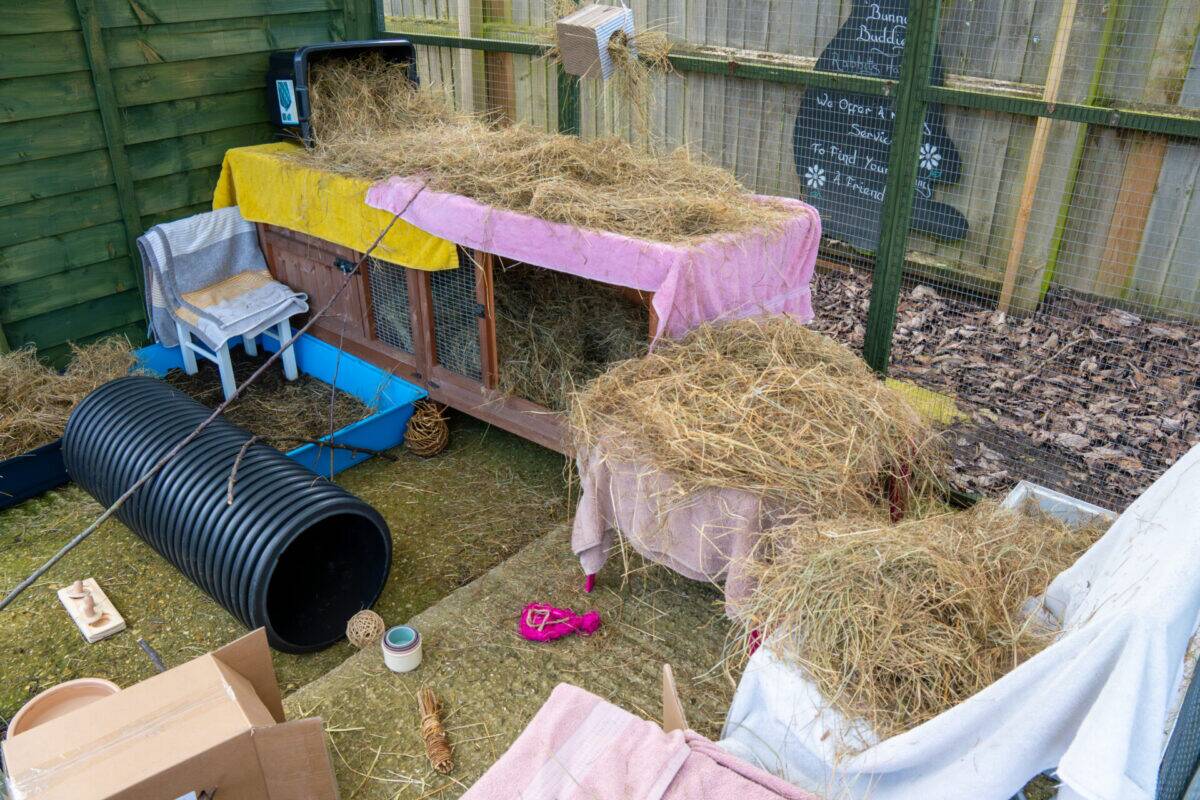
Outdoor rabbit hutch covered with towels and hay, surrounded by hay piles, cardboard boxes, a black plastic tunnel, and rabbit toys within a fenced enclosure.

A walk in rabbit run with a hutch, dig tray, tunnel, platforms, hiding spaces and lots of hay.

Indoor pros

Outdoor pros

  • Your rabbits are likely to become
    more confident around you and
    being hand-fed.
  • There’s a better chance you’ll
    spot health concerns quickly.
  • They’ll be safe from wild
    predators and extreme
    weather.
  • It’s a calmer, quieter area
    away from household noises
    and other indoor pets.
  • If anyone in your home
    suffers from allergies, it’s
    safer for them.
  • The rabbits will have a
    natural temperature all
    year-round

Indoor cons

Outdoor cons

  • They can be litter trained, but
    you may still find their faeces,
    urine (and lots of their hay!)
    scattered around.
  • They’re likely to chew and gnaw
    on any wooden furniture, skirting
    boards and even wires if they’re
    not moved out of reach.
  • They’ll have less opportunities to
    graze on grass. If they’re given
    this option from time to time,
    they’ll need time to acclimatise
    to the outside temperatures.
  • You may be allergic to their
    bedding, and this is no fun at all!
  • There’s less opportunity
    for you to socialise with
    your rabbits.
  • They’re more likely to
    have health issues that
    go unnoticed for longer
    periods.
  • They’ll be at risk of wild
    predators such as foxes
    and stoats if their
    enclosure is not secure.
  • They will need extra
    protection from extreme
    weather – both hot
    and cold

Shelter

Hutches

You’ll find many rabbit hutches available in pet stores and online. But many are very poorly made and often fall apart within the first two years. So, if you can, you should consider investing a little more with a product produced by a welfare-approved company. A good hutch is one made of strong wood, with secure bolts fitted on the doors and sturdy wire mesh.

Avoid double level-hutches as these have ramps which are usually very steep and not long enough to allow your rabbits to gain enough momentum to hop up them safely. They can also be at risk of falling down the ramp or floor hole when they are elderly and less mobile. If you already have a double-level hutch, remove the ramp and replace it with a sturdy log or box, securely covered in an old towel or blanket to provide some grip. They will find it much easier and more natural to hop up onto this and then up to the top level.

Wooden Wendy Houses or garden sheds

These can make an ideal home for your rabbits. A shed or wendy house provides more floor space, and makes it easier to socialise with them, whatever the weather. You can easily convert a shed or Wendy House.

Chicken coop and run combinations

These are also unsuitable. It’s very unlikely that you’ll find one meeting the minimum size requirements for the sheltered sleeping area and the run. They can also be very tricky to clean, and make socialising with your rabbits difficult.

Your outdoor run

Rabbits are very active animals, particularly at dusk, dawn and overnight, so it is important that they have 24hr access to their run if they are living outdoors. The run will need to be well-built (we recommend having a wooden framed run with a wooden framed lid), to prevent predators from getting in, as well as preventing the rabbits from escaping.

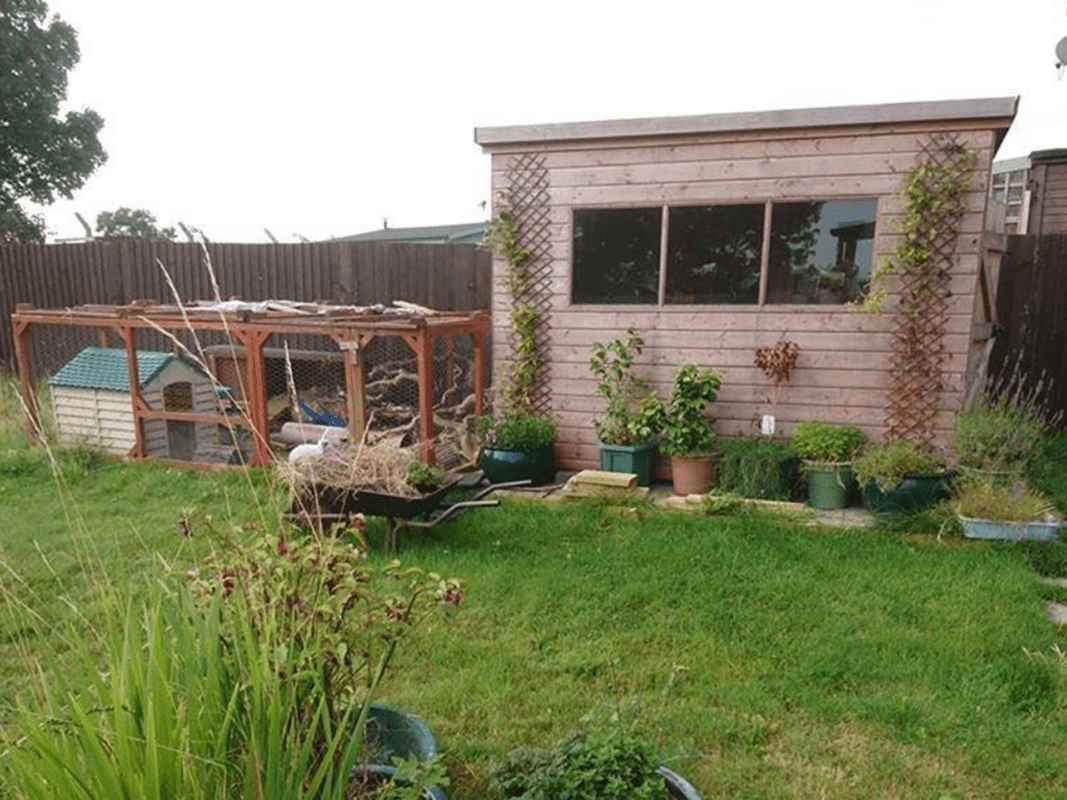
A wooden garden shed with potted plants sits beside a large outdoor animal hutch and green lawn. A wheelbarrow, garden tools, and a fenced area are visible in the grassy back garden.

A converted shed with attached run for a pair of rabbits to have continuous access to.

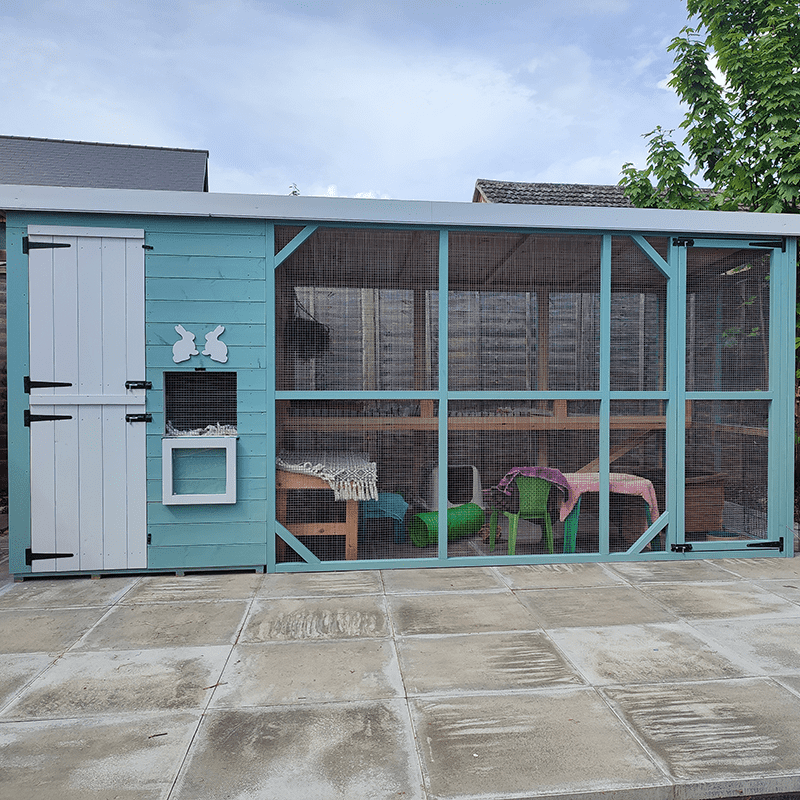
A large outdoor cat enclosure with a blue wooden structure, white door, mesh walls, and shelves inside. There are cat toys and blankets visible through the mesh. The enclosure sits on a paved patio.

Indoor housing

Whilst rabbits can live indoors, you’ll need to consider this decision carefully as it can have quite an impact on your home. Your rabbits will still need as much space indoors as they would outdoors – an area at least 3m x 2m in size. The easiest way to achieve this for a pair of standard sized rabbits is to convert a room into their own rabbit haven – and you’ll have a lot of fun getting creative with it! Giant breed rabbits may need multiple rooms, depending on their size.

Things you’ll need to consider with indoor rabbits

  • A baby gate or similar to keep them secure in the room but enable them to see what’s going on
  • Unless the floor is carpet, you should consider rugs or plenty of ‘hop to’ areas, as slippery flooring can cause muscle wastage or back damage
  • Your rabbits will need a room with natural sunlight and a steady, comfortable room temperature that will aid their natural twice-a-year moult
  • All electrical wires or plastic water pipes will need protecting from being chewed
  • All household plants will need to be removed
  • Provide lots of toys and activities, like dig trays, litter trays and items for them to hop on to and run through
  • Be prepared for chewing of furniture, faeces and urine stains on flooring.

Enrichment

When creating your rabbits’ environment, choose items that will encourage and support natural behaviours such as digging, foraging, exploring and hiding. This will keep them active and mentally stimulate them – all the ingredients for healthy and happy rabbits.

There are lots of things you can use to create a stimulating environment for your rabbits – here are some ideas to get you started.

  • Cat carriers lined with newspaper and lots of hay. These can make great hiding places, but place a towel or blanket on top to prevent them from slipping.
  • Large cardboard boxes. Be sure to cut a few rabbit-sized holes into the boxes to give them multiple entrances and exits. As with cat carriers, place a towel or blanket on top. Monitor for signs of chewing and remove if necessary as eating cardboard can cause gut blockages in rabbits.
  • Large rectangular cat litter trays or dog beds lined with newspaper and filled with lots of hay. This can help a lot with litter training!
  • Dig tray or old car tyre. Be sure to fill with organic compost, sand or hay.
  • Large tunnels. These are great for hopping through – large plastic pipes are useful for this.
  • Children’s tables and chairs. Place a towel or blanket on top to stop them slipping and falling when they jump on it and to provide somewhere for them to hide.
  • Garden hanging basket or magazine rack stuffed full of hay. Hang the baskets up in the run for them to reach up and browse from. Also, you must keep them topped up with hay to prevent injury if they were to jump into them.
  • Apple or willow tree branches and twigs. These are great for gnawing on! Your rabbits will love the tasty bark and it’s good for their digestive system too.
  • Paper bag half filled with hay and freshly picked, safe plants. Make sure you cut the handles off before they have a good rustle around.
  • Stuffed toilet roll tubes with hay or forage hay. These are a perfect treat for your furry friends to find in a fun way!
  • Safe plants and herbs in pots. Your rabbits will enjoy nibbling on these.
  • Grass in large litter trays. This is ideal for rabbits who don’t have access to grass.
  • Puzzle feeders. You can purchase these or make your own. We recommend using egg boxes and cardboard tubes to place their dried food into.

For more ideas, check out our ‘How to create the perfect environment for your pet rabbits’ article.

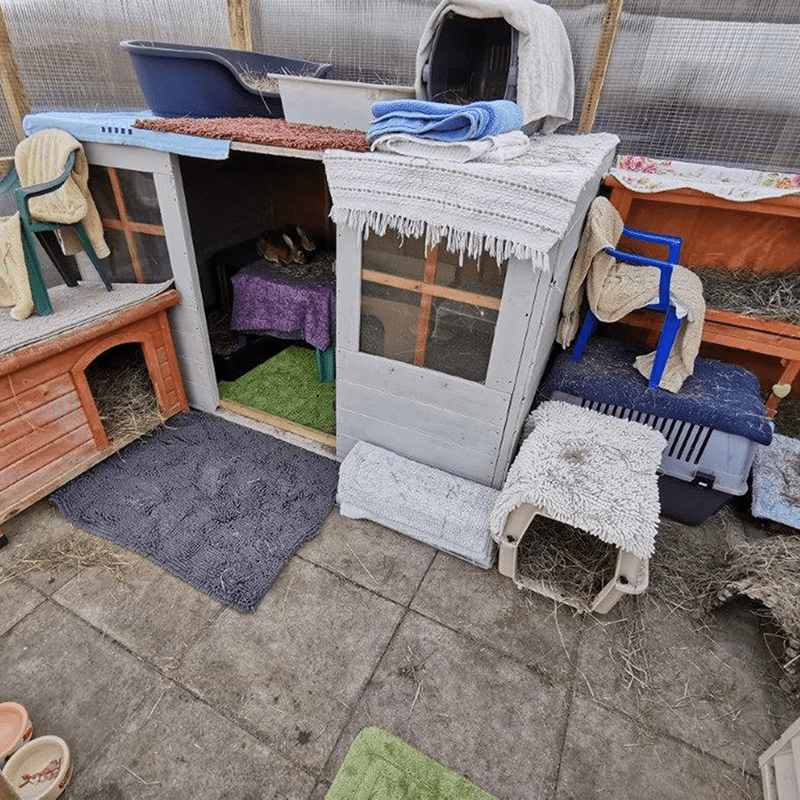
A cosy outdoor enclosure with small animal huts, cages, blankets, and mats, arranged for pets like rabbits or guinea pigs. Bowls and hay are scattered around the set-up, providing comfort and shelter.

'An outdoor enclosure filled with multiple hiding spaces, platforms, hay and litter trays.

Bedding materials

Like us humans, rabbits like a comfy bed – and it’s what they deserve! The wrong bedding for rabbits can have a negative effect on their health. Wood shavings, sawdust and straw often contain fur mites, cause respiratory conditions and can give humans an allergic reaction too!

The only way is hay

The most suitable bedding for your rabbits is green sweet-smelling hay. As you may know, it also makes up a large chunk of their diet, so it has multiple uses!

Top tips:

  • Place vinyl or lino under newspaper and hay in hutches or sheds to make it easier to wipe clean.
  • Line multiple rectangular litter trays with newspaper and place lots of hay on top.
  • Place large piles of hay around their enclosure.
  • Or cover the flooring of any hutches or sheds with a good layer of hay.

It’s often more cost-effective to purchase hay from a local farm or equine shop by the bale. You can then pick a nice, green bale and reduce the risk of it being old stock and possibly contaminated or filled with sharp thistles. For examples of different hay to use, see the diet section below.

Fun (but serious) fact: some people can be allergic to hay, mistakenly thinking they are allergic to the rabbits themselves.

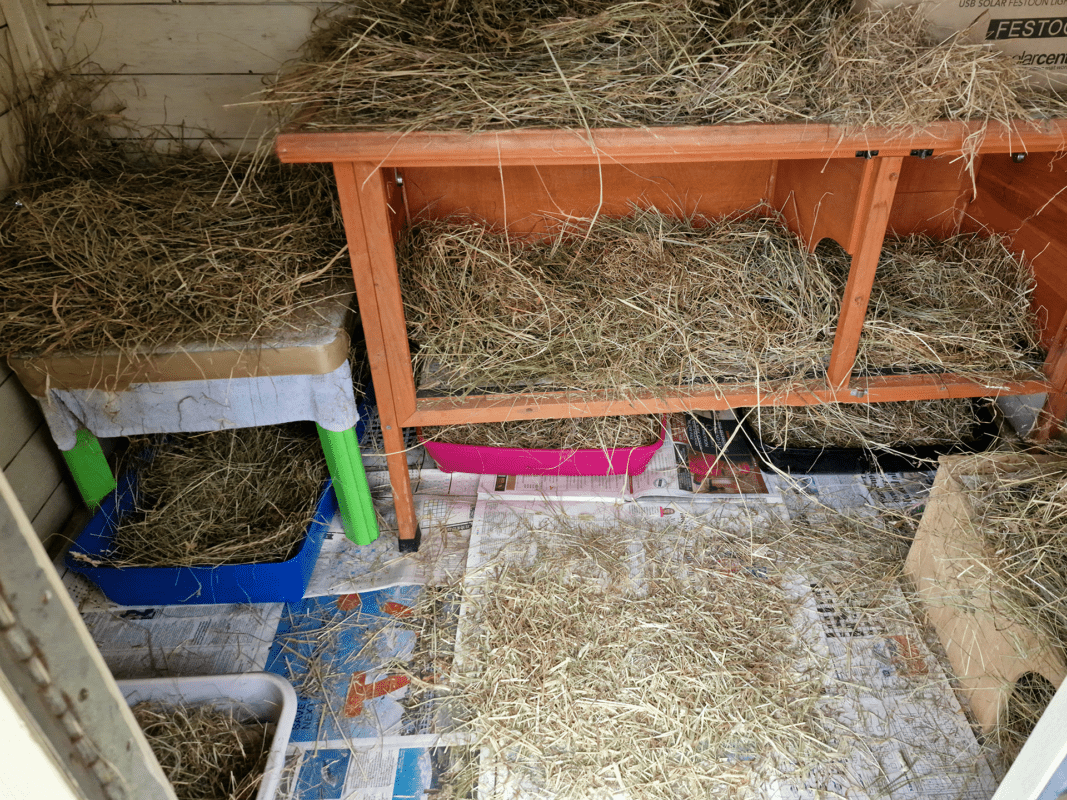
A small animal enclosure with wooden furniture, several plastic litter trays, and cardboard boxes, all scattered with hay. The floor is covered with paper and hay, creating a cosy habitat.

'Shed lined with newspaper, and hay placed within hiding spaces and litter trays

Cleaning

Keeping your rabbits’ accommodation clean is key to preventing serious health conditions. Here’s how to keep it as immaculate-looking and safe as possible:

Daily – Spot clean

This is vital in the summer months to help prevent flystrike (a painful and life-threatening condition).

  1. Empty any used litter trays and remove any other soiled bedding.
  2. Replace dirty bedding with fresh hay.
  3. Change their water.
  4. Remove any greens/ vegetables they have not eaten from the previous day.

Weekly – refresh clean

As well as keeping your rabbits’ home in tip-top condition, this also helps with the prevention of flystrike.

  1. Place your rabbits in a secure plastic cat carrier with plenty of hay. Keep this in a safe, quiet space away from where you are cleaning.
  2. Remove any used litter trays, bowls, bottles and any regularly used enrichment/hiding spaces. Clean with a pet-friendly disinfectant.
  3. Set aside all of the clean, unsoiled hay and sweep out their enclosure. Wipe any soiled areas with pet friendly disinfectant.
  4. Replace the hay you saved in step three and add fresh bedding and place the enrichment back in, and throw in some new toys if you can. Make sure some toys and enrichment remain in the enclosure that have not been cleaned to help with the rabbits settling back in.

Back to contents


Rabbit companionship

Rabbits are very social animals who depend on the companionship of other rabbits to live their best life. Human companionship is not enough, so they should always be kept in pairs or groups. If you find yourself with a lone rabbit of any age, contact Woodgreen or your local rescue centre to help find your rabbit a companion.

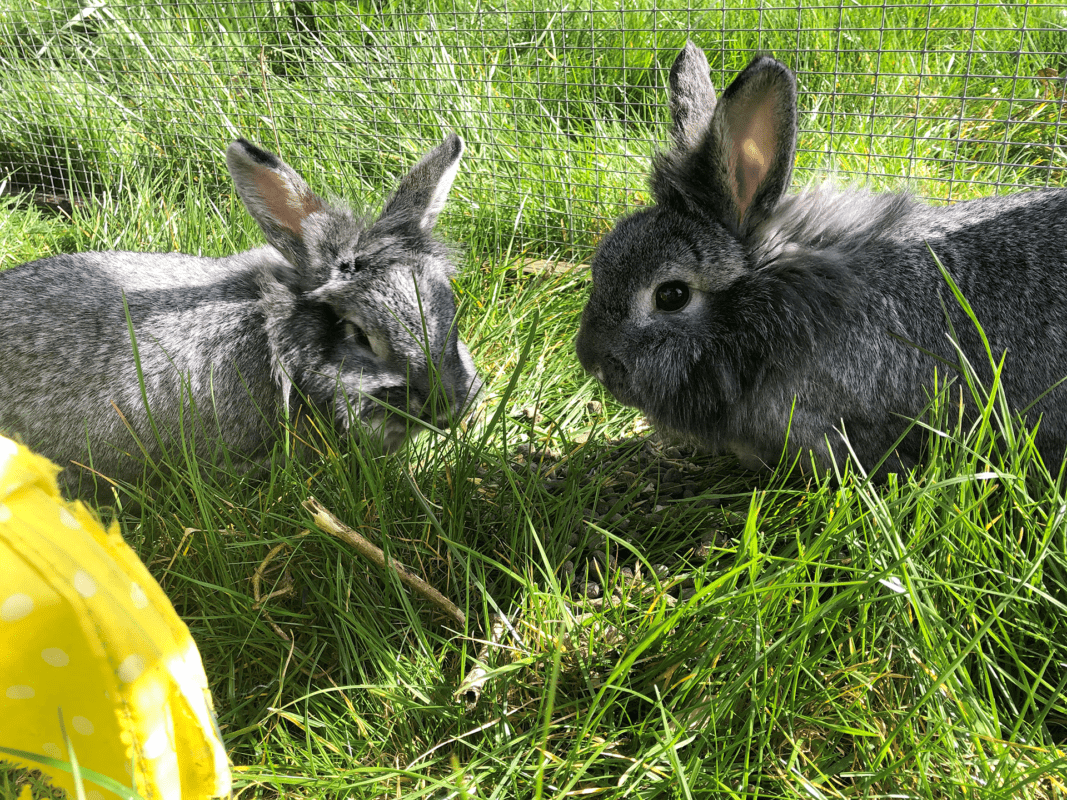
Two fluffy grey rabbits sit facing each other on green grass in a sunlit outdoor enclosure. A yellow object with white dots is partially visible in the lower left corner.

Suitable combinations:

  • A neutered male and neutered female rabbit.
  • Same-sex pairs can work, but it’s important they’re neutered as early as possible – ideally between three to six months – to prevent potentially fatal fights as they mature.
  • You can bond different breeds together, but take care when considering a giant with a smaller breed. While many mismatched- size pairings can work, there’s always a risk to the smaller rabbit during the mixing process.

Unsuitable combinations:

A rabbit and a guinea pig should not live together.

Although some owners have found success with this type of paring, there’s a big risk that the guinea pig will be accidentally kicked when the rabbit is running or hopping about. Guinea pigs are also vocal communicators, while rabbits are mostly silent. This can be upsetting for both the rabbit and guinea pig.

Back to contents

Introducing your rabbits to each other

Before we get started on this topic, don’t forget, if you find yourself with a lone rabbit, please contact us! We have an onsite mixing service and we could match them with a companion either by mixing onsite or by providing you with advice on how to mix them at home.

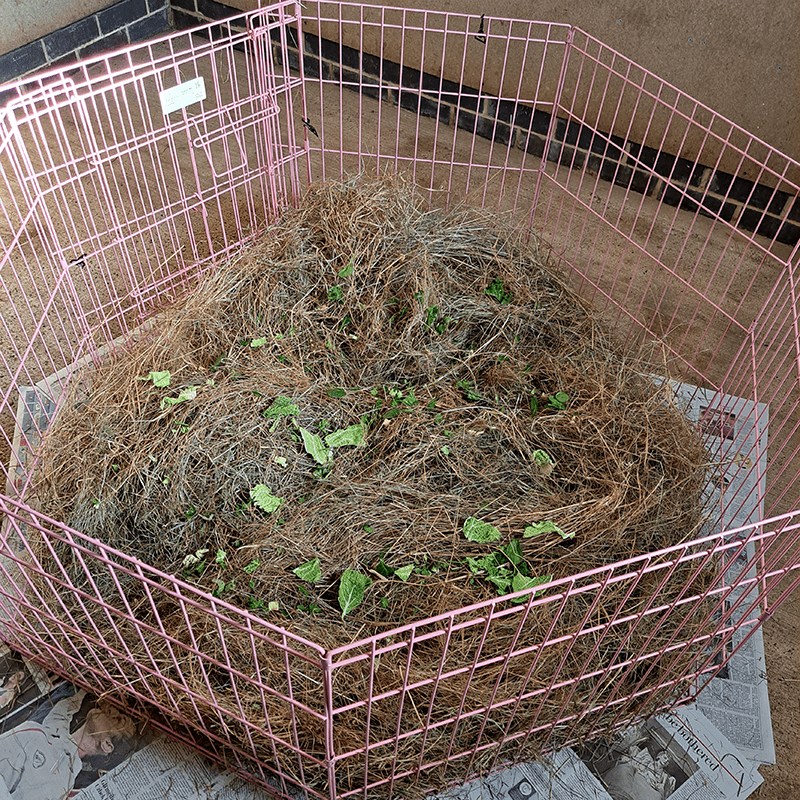
A pink metal playpen is placed on newspaper, containing a large pile of hay with scattered pieces of green leafy vegetables on top. The setup is indoors with a brown floor and beige wall background.

A playpen for mixing (?)

Preparing to mix

Like us humans, there’s no guarantee that sparks will fly when two (or more) rabbits meet for the first time. But there are things you can do to increase the chances of success!

First, you’ll need to make sure that the rabbits are neutered, as it will not only prevent any unwanted litters, but will also help with their bonding.

When introducing, this needs to be done in a neutral space which doesn’t contain the scent of either rabbit. There are a few different mixing methods you can try which are split mixing, larger space method and smaller space method.

Find out more about the different mixing methods.

We also recommend watching our video on choosing the right companion for your rabbit, how to mix them, and behaviours to look out for here:

Feeding your rabbits

To help your rabbits live a long and healthy life, their diet should be as natural and varied as possible.

Rabbits in the wild spend their days grazing, and they need a full tummy of fibre at all times. A healthy daily diet should include the following:

Hay

Place this in large piles around their enclosure, in large trays, inside/on top of hiding spaces and in hay racks. Rabbits need constant access to hay/grass, as they will continuously eat. It’s also great for helping to keep their teeth healthy.

Offer a mixture of varieties such as:

  • Baled mixed meadow hay.
  • Forage treat hay by Burgess.
  • Timothy hay.
  • Small amounts of Readigrass.

Avoid short, brown or yellow, dusty “or mouldy” smelling hay as it’s not very nutritional and may harm your rabbits.

Nuggets

Give approximately 15g of nuggets per kilo of bodyweight to each rabbit daily.

Although this will depend on their age, weight and current health. Rabbits should not be fed muesli mixes as they are high in sugar and can lead to selective feeding which can lead to dental problems. Here at Woodgreen, we feed our rabbits on Burgess Excel Nuggets, which you can buy online or from most pet shops.

Safe plants and vegetables

A large handful per rabbit, per day. Give them a variety of different fresh foods each day. You can even pick and grow your own foods to feed them – see our list of safe foods below, and visit our rabbit feeding article for more ideas.

Water

Daily fresh water is extremely important. Many rabbits prefer to drink from a bowl. Bottles are suitable but can often leak and be tricky to clean. Provide one water source per rabbit

Back to contents


Forage for your rabbits

As well as the food and snacks, there are all sorts of other natural foods – or forage – you can give your rabbits. And, if you fancy getting out into nature, you can go foraging to pick and collect lots of them yourself, for free!

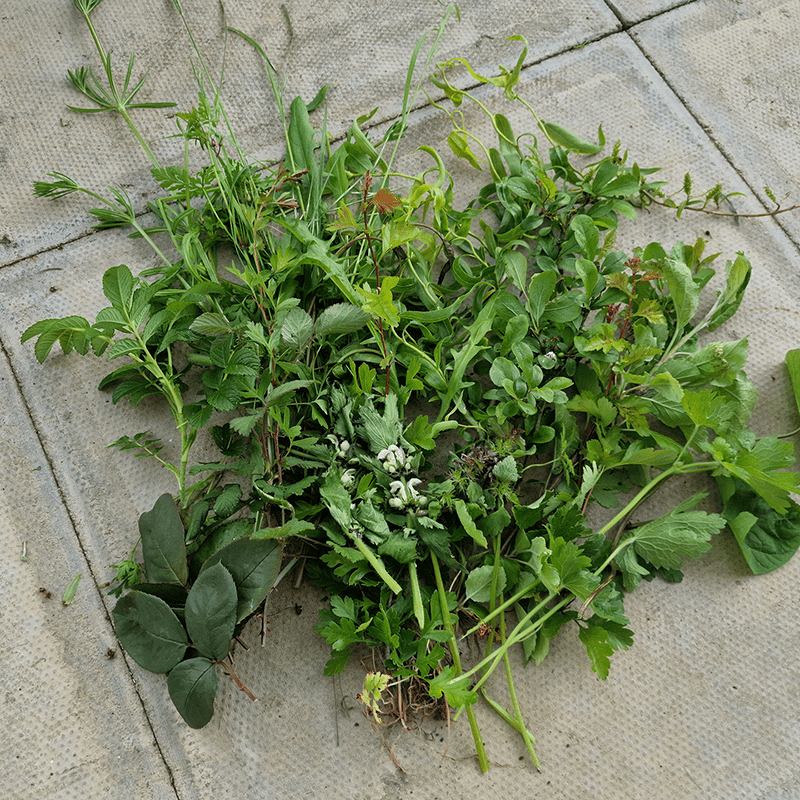
A variety of freshly picked wild green plants and herbs, ideal to forage for guinea pigs, are spread out on a tiled surface, showcasing different leaf shapes, sizes, and shades of green.

A variety of freshly picked wild green plants and herbs; ideal forage for guinea pigs or rabbits.

What is forage?

Forage is food you can gather from where it grows naturally, and it doesn’t cost you anything.

It’s more natural and closer to the diet these animals would have in the wild.

It’s also:

  • Healthy and lower in sugar than vegetables and fruit.
  • A good way to make sure your pets are getting enough fibre, vitamins and minerals.
  • Great for adding variety and enrichment to your pets’ diet.
  • A brilliant way to naturally wear your pets’ teeth down and help prevent dental diseases.

Pick carefully!Never collect protected plants or plants you don’t recognise

Ideas on what to feed your rabbits

  • Blackberry bramble
  • Chickweed
  • Clover
  • Cow parsley
  • Common agrimony
  • Cranesbill
  • Dandelion
  • Dead nettle (white or red)
  • Dog rose
  • Golden rod
  • Good King Henry
  • Goosegrass
  • Grass
  • Greater stitchwort
  • Ground elder (before flowering)
  • Hawksbeard
  • Hawkweed
  • Hawthorn
  • Herb bennet (Wood avens)
  • Herb robert
  • Mallow
  • Meadowsweet
  • Nettle
  • Nipplewort
  • Plantain (rib and broad leaf)
  • Prickly lettuce
  • Shepherd’s purse
  • Silverweed
  • Sow thistle
  • Willowherb
  • Yarrow

Where can I get it?

You’ll find it in hedgerows, footpaths, fields and woods.

Here are a few tips for success:

  • Don’t collect it from the roadside – it may be contaminated with exhaust fumes.
  • Avoid areas which may have used weedkiller, fertilizer or other chemicals.
  • Avoid paths and verges used by dogs or near poop bins.
  • Don’t trespass on private land!

Different types of forage

Wild plants

You can find all sorts of edible plants and branches in fields, hedgerows and even in your own garden– and you can feed your pets most of them fresh. But there are some, like nettles, that are better dried.

Read our article on what to feed your rabbits to find lots of safe plants, twigs and branches you can forage and feed your rabbits.

Fruit and vegetables

Although you may not be able to ‘forage’ for fruit and vegetables as easily, here’s a list of what’s safe for your pets:

Vegetables

  • Broccoli
  • Brussel sprouts
  • Cabbage
  • Carrot tops
  • Cauliflower
  • Celery
  • Courgette
  • Curly kale
  • Fennel
  • Pak Choi
  • Peppers
  • Pumpkin
  • Radish tops
  • Rocket
  • Spinach
  • Spring greens
  • Swiss chard
  • Squash
  • Watercress

Fruit

As an extra, occasional treat, you can give your pets a small piece of apple, pear or tomato.

Rabbits also love to eat strawberry leaves, blackberry leaves and raspberry leaves (not the fruits).

Back to contents


Handling your rabbits

Whilst rabbits are known to be a popular children’s pet, they’re only really suited for families who are happy to give them plenty of space. That means socialising with them by sitting on the floor nearby and not cuddling them. But they can still make a wonderful addition to a family!

Rabbits prefer to have all four paws on the floor and find being picked up and cuddled extremely stressful. This can lead to you being scratched, kicked or bitten as they try to struggle to break free. This is not an aggressive behaviour; it’s a natural way for them to escape from a potential ‘predator’, like they would in the wild.

You may expect that the more you handle a rabbit, the calmer they will become. Sadly, this can actually have the opposite effect. In fact, it can lead to them being even more fearful and warier of humans. The best way to spend time with your rabbit is to sit on the ground in their run area and offer tasty treats. If you’re able to do this with your rabbits daily, you’ll soon find they happily choose to hop and sit on your lap or follow you around.

Transporting your rabbits

It’s important that you always have a suitable pet carrier available in case you need to rush your rabbits to the vet. These are also handy for when you need to clean out their enclosure. Cardboard boxes can quickly and easily be chewed through, leading to escapees – so avoid these!

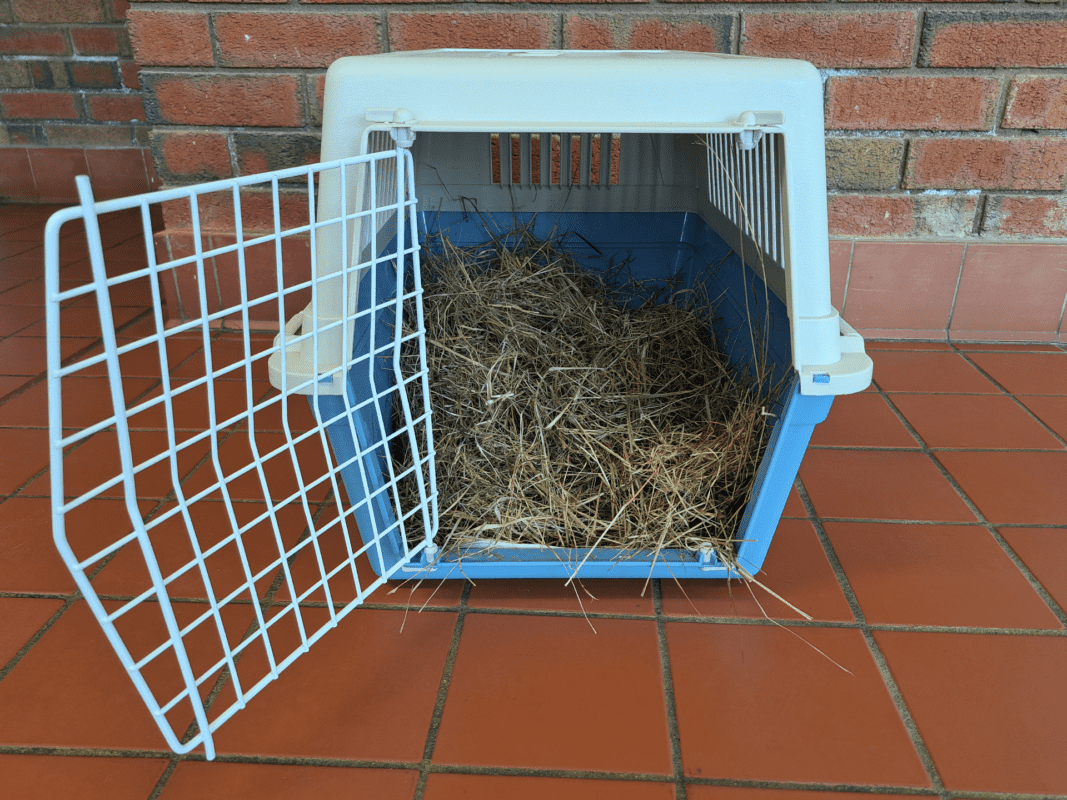
Hard plastic cat carriers like this one are perfect for your rabbits. To keep them relaxed and happy, make sure the carrier is large enough for both rabbits, so they don’t need to be separated. Place some newspaper on the bottom with lots of hay on top for them to munch on.

A blue and white pet carrier with an open metal door sits on a red tiled floor. The carrier is filled with hay. A brick wall is visible in the background.

A hard plastic cat carrier, which can be used to transport rabbits.

Keeping your rabbits healthy

Make sure you health check your rabbits every week, and look out for any changes in their behaviour every day. Unfortunately, they can be very good at hiding any health issues until they’re really suffering.

Sometimes, even the smallest thing can be a sign your furry friend is poorly. Like not rushing out to receive fresh food straight away, or their poo looking a little smaller, darker, harder or softer than normal. If you have any concerns, act quickly and contact your rabbit savvy vet.

Watch our video on how to health check rabbits and what to look out for.

Dental health

Did you know that poor dental health is one of the most common killers in rabbits? This is often because of an incorrect diet or due to genetics. Rabbit teeth continually grow, so a diet of at least 85% hay/grass is essential in helping to reduce the risk of dental disease.

Signs to look for include:

  • One or both eyes weeping or blocked tear ducts
  • Weight loss
  • Drooling
  • Mucky bottoms or regularly finding soft stools within the accommodation
  • Lumps/abscess along the jawline
  • Lack of appetite, choosing not to eat particular foods that they enjoyed previously, or choosing to eat softer foods over harder foods
  • Flystrike disease
  • Overgrown front teeth with matted fur wrapped around them.

Sadly, dental disease is rarely treatable, only manageable. It can lead to a very slow and painful deterioration of your rabbit. So it may be kinder to put them to sleep sooner rather than later, with the support of your rabbit-friendly vet.

Dental disease cannot always be prevented but ensuring your rabbits have a good diet, full of fibre can help to keep their teeth in check

Gut stasis

As the name suggests, this is when the rabbit’s gut slows down or stops moving, and it’s a symptom of something else going on. Rabbits always need to have food passing through their gut to help keep the bacteria in them healthy and working. Being a prey species, they tend to hide that they’re feeling unwell for as long as possible.

It’s important to look out for the following symptoms:

  • Lack of appetite or stopping eating altogether
  • Appearing hunched with a bloated belly
  • Appearing to struggle to get into a comfortable position
  • Producing very few, if any, droppings, which are smaller and darker in colour than usual.

If you notice any of these, please take them to a vet immediately. If not treated quickly enough, these symptoms can be fatal.

Sometimes, owners decide to wait until the next day to see if they improve. Sadly, it’s often too late at this point. Once treated, your vet can then investigate the cause of the gut stasis and discuss with you the ways to prevent it from reoccurring.

There are some things you can do to help prevent gut stasis. Make sure your rabbits have a diet consisting of 85% hay/grass, 10% safe plants and vegetables, and 5% nuggets. You should also groom your rabbits when they moult as this can help to prevent them from ingesting too much fur, which could cause a blockage. Long-haired rabbits will need to be groomed more regularly.

Stress, loud noises, living alone or living with an incompatible rabbit, can all cause gut stasis too.

Vaccinations

Your rabbits will need vaccinating twice a year – one to help protect them against Myxomatosis and RVHD1 and 2 (Rabbit Viral Haemorrhagic disease), and the other for the newer highly virulent RVHD2 strain. All are fatal and easily contracted.

RVHD is very much a ‘silent killer’, with little or no symptoms. The virus can reach your rabbits via your clothes and footwear if you’ve unknowingly been in contact with it, or through another rabbit in the early stages of the condition.

Myxomatosis is spread by mosquitos, fleas, and can also reach rabbits via your clothes and footwear.

For these reasons, both outdoor and indoor rabbits are at risk.

Signs of myxomatosis:

  • Puffy, red or swollen eyes and genital area
  • Small bumps and lumps in the ears and across their body
  • Noisy breathing
  • Sitting hunched
  • Crusty lump on the nose
  • Eyes shut with a glue-like appearance.

Signs of RVHD1 and 2:

  • Jaundice
  • Sudden collapse where death follows within hours
  • Projectile diarrhoea followed quickly by death
  • Loud scream followed by death
  • Sudden death with no symptoms

Read our article to find out more about the importance of vaccinating your rabbits.

Back to contents
Finding a vet

It’s really important to find a vet in your area who has lots of experience with rabbits. Most vets will see cats and dogs on a daily basis and will have extensive knowledge of their needs. Other species such as rabbits may not be seen very frequently by most vets. So finding someone who has lots of experience of seeing, diagnosing and treating rabbits is vital.

  • Look for an Exotics Veterinary Practice – they may have more experience and be cheaper in the long term than other vets. Look here to find a rabbit-friendly vet in your area: Recommended Rabbit – Friendly Vets | Rabbit Welfare Association & Fund (RWAF)
  • Talk to friends and family who own or have owned rabbits to see if there are any vets they recommend.
  • Talk to veterinary practices to find out if there are any rabbit savvy vets within the practice. Don’t be afraid to ask them how many they see and treat on a weekly basis. This can help you decide whether they are the right vet for you.

Back to contents


Looking for more expert pet advice?

We cover a range of different topics on our website – and not just for your small furry friends, but cats and dogs, too!

Not only that, but we also offer phone appointments, workshops, training classes, webinars and courses.

Visit our pet advice hub or call 0300 303 9333

How helpful was this?

Thanks for your rating

Rated this article 3 stars or less? Tell us what we could do to make it more helpful.

0
(0)
Let's do it